- October 27, 2026
Hydraulic systems depend on clean fluid to operate reliably. Even relatively small particles can contribute to wear, restrict small passages, interfere with valves, and shorten the service life of pumps and other components. But a properly specified hydraulic filter mesh helps control that contamination while allowing the system to maintain the flow it needs.
Choosing the right mesh, however, requires more than finding a material with the desired micron rating. Engineers and procurement teams also need to consider filtration efficiency, flow rate, differential pressure, operating temperature, fluid compatibility, mesh construction, and the mechanical demands placed on the hydraulic filter element.
The correct filtration mesh therefore depends on the complete operating environment. Understanding those requirements before specifying the material can help prevent premature clogging, excessive pressure drop, inadequate filtration, and unnecessary filter replacement.
Benefits of Hydraulic Filtration Mesh
The primary purpose of hydraulic filtration is to remove contaminants before they interfere with system performance. Metal mesh provides several additional advantages that make it useful in a wide range of industrial filtration applications.
Reliable Particle Control
A hydraulic filter screen creates a physical barrier that captures particles above a specified size while allowing hydraulic fluid to pass through. Depending on the construction and filtration requirement, wire mesh can be used for coarse particle removal, as a supporting layer within a filter element, or as part of a more precise multilayer filtration system.
High Mechanical Strength
Metal filter mesh can withstand conditions that may damage less durable filtration media. This can be particularly valuable when filters experience pressure fluctuations, high flow rates, vibration, or repeated cleaning.
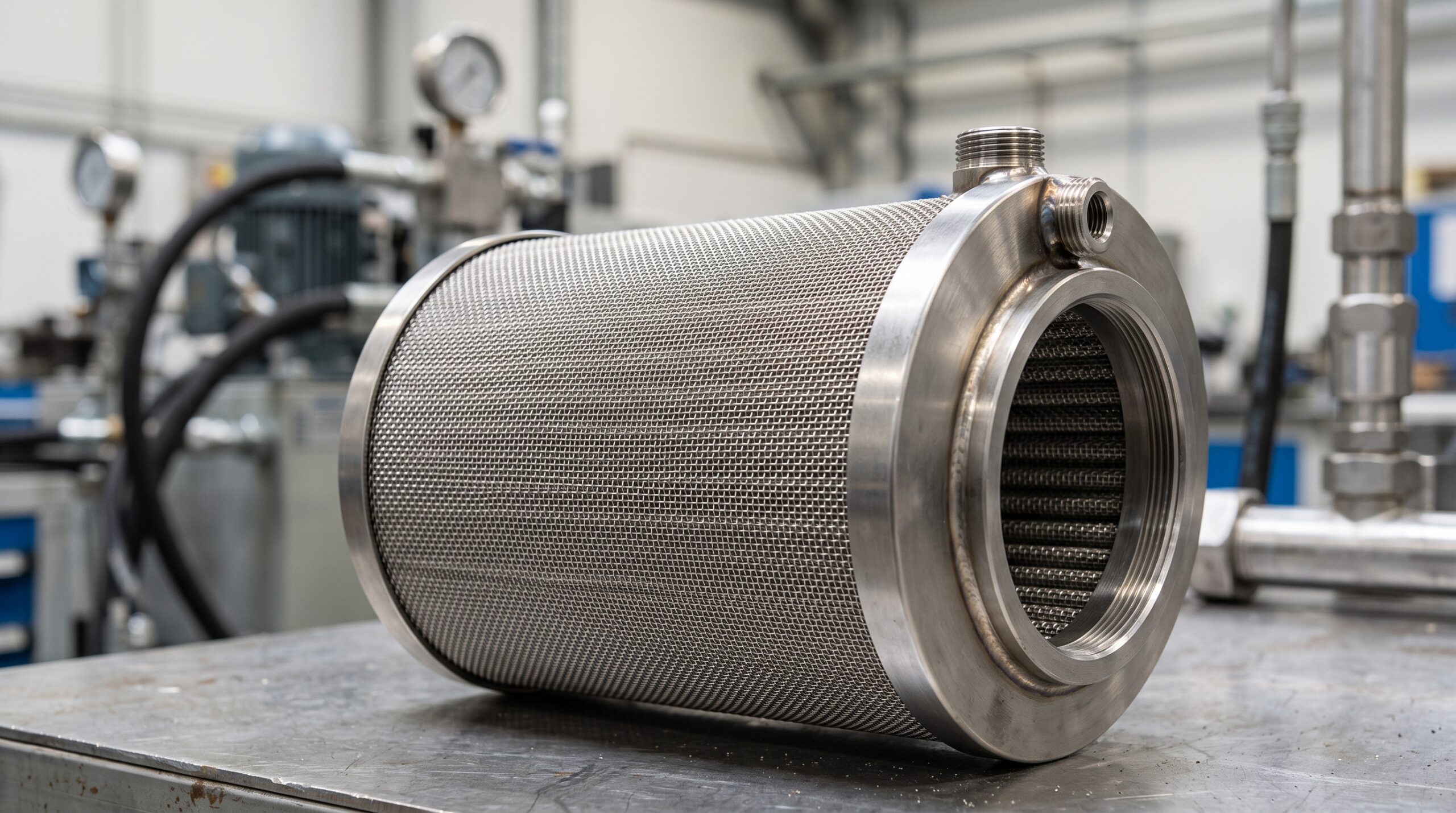
Sintered wire mesh provides additional mechanical stability because multiple layers of mesh are bonded together into a single porous structure. Lawrence Sintered Metals commonly positions this construction for demanding filtration applications where strength and consistent porosity are important.
Resistance to Heat and Corrosion
Material selection allows filtration mesh to be matched to the fluid and operating environment. Stainless steel is commonly used where corrosion resistance, durability, and temperature tolerance are important. Specialty alloys may be appropriate when a hydraulic system is exposed to particularly aggressive chemicals or demanding operating conditions.
Cleanability and Reusability
Depending on its construction and the contaminants involved, metal filtration media can often be cleaned and returned to service. Sintered wire mesh filter cartridges, for example, are available in back-washable constructions for liquid and gas filtration.
For applications where cleaning is practical, reusable metal media can help reduce the frequency of complete element replacement.
What to Consider When Selecting Hydraulic Filter Mesh
The best wire mesh for hydraulic filters is determined by how the complete filtration system operates. Several specifications should be evaluated together.
- Filtration Rating and Efficiency
Micron rating is usually one of the first specifications considered because it indicates the size of particles the filter is intended to control. However, micron rating alone does not fully describe filter performance.
Two filters described using the same micron size may have very different efficiencies at capturing particles of that size. In hydraulic filtration, Beta ratios are commonly used to provide additional information about filtration efficiency. Under ISO 16889 testing, for example, a Beta ratio of 200 corresponds to 99.5% efficiency at the specified particle size, while a Beta ratio of 1,000 corresponds to 99.9%.
This distinction matters when comparing filtration products. Specifying only “10 micron,” for example, does not explain how efficiently the filter must capture particles at or above that size.
For a mesh supplier, the important starting point is understanding the required particle retention and how the mesh will function within the finished filter design.
- Mesh Construction
The way the mesh is constructed affects pore characteristics, strength, flow, and overall filtration performance.
Plain weave, twill weave, and Dutch weave constructions offer different combinations of filtration capability, flow characteristics, and mechanical properties.
The appropriate construction depends on the application. An open woven mesh may be suitable for coarse filtration or support, while a Dutch weave can provide finer particle retention. A multilayer sintered structure can be selected when the application requires greater mechanical stability and controlled filtration characteristics.
- Flow Requirements and Pressure Drop
A filter must capture contaminants without unnecessarily restricting the movement of hydraulic fluid.
Smaller openings generally improve particle retention, but they can also increase resistance to flow. As contaminants accumulate, that resistance can increase further. Lawrence Sintered Metals’ existing filtration guidance summarizes the relationship well: if an aperture is too fine, the system may clog, while an opening that is too large can allow unwanted particles to pass through.
When selecting a hydraulic filter screen, consider the required flow rate, available filtration area, fluid viscosity, acceptable pressure drop, and expected contaminant load. These factors should be evaluated together rather than treating mesh opening as an isolated specification.
- Operating Pressure and Differential Pressure
Hydraulic systems can operate under substantial pressure, but the pressure acting on the filter media is not necessarily the same as the overall system pressure. The differential pressure across the filter element is particularly important because the media must retain its shape and filtration characteristics as resistance increases.
Pressure spikes and changing operating conditions also need to be considered. A mesh that performs adequately under normal conditions may not be suitable if it deforms during startup, cold-fluid operation, or an unexpected pressure surge.
Sintered mesh can be useful where greater structural stability is required because the bonded layers create a strong, self-supporting filtration medium. Commercial sintered wire mesh filtration products are used in high-pressure applications specifically because of these mechanical properties.
- Operating Temperature
Temperature affects both the filtration material and the hydraulic fluid. As temperature changes, fluid viscosity changes as well, which can affect flow and pressure drop across the filter. The mesh material must also tolerate the application’s expected operating temperature without losing the mechanical or corrosion-resistant properties required for reliable filtration.
High-temperature environments may favor stainless steel or an appropriate specialty alloy rather than media that cannot tolerate prolonged heat exposure.
- Fluid and Chemical Compatibility
Hydraulic systems do not all use the same fluids. Petroleum-based oils, water-glycol fluids, synthetic fluids, emulsions, and specialty hydraulic fluids can create different compatibility requirements.
The mesh alloy should therefore be selected with the actual fluid chemistry in mind. Stainless steel hydraulic filter mesh is widely useful because of its corrosion resistance and strength, but more aggressive operating environments may require another alloy.
- Cleaning and Maintenance Requirements
Consider what will happen after the filter captures contaminants. If the filter element will be cleaned and reused, the mesh must tolerate the intended cleaning process. The construction should also allow contaminants to be removed effectively without damaging the media or changing the openings.
For disposable elements, service interval and dirt-holding requirements may carry more weight. In either case, maintenance requirements should be considered during specification rather than after the filter has entered service.
Common Mesh Types Used in Hydraulic Filtration
Different hydraulic filtration applications call for different types of metal mesh. Understanding the basic differences can help narrow the specification.
Woven Wire Mesh
Woven wire mesh is made by interlacing wires in a controlled pattern. Depending on wire diameter, opening size, and weave, it can provide predictable openings and good flow characteristics.
In hydraulic systems, woven mesh is often useful for coarse filtration, strainers, protective screens, reusable elements, and support layers. Commercial hydraulic filtration systems commonly use wire mesh at coarser filtration levels, with examples in approximately the 40 to 150 micron range depending on the product and application.
Different weave patterns can also change performance. Plain weave offers a straightforward opening pattern, while twill and Dutch weave constructions can provide different combinations of strength, flow, and finer filtration.
Dutch Weave Wire Mesh
Dutch weave uses different wire arrangements and diameters in the warp and weft directions to create a dense filtration structure. Instead of relying on simple square openings, its construction creates a more tortuous path through the mesh.
This makes Dutch weave useful when finer filtration is required while retaining the strength and cleanability associated with metal wire cloth.
Sintered Wire Mesh
Sintered wire mesh consists of multiple layers of woven mesh bonded together through heat and pressure. The resulting material combines filtration layers with supporting layers to produce a stable porous structure.
This construction can be particularly useful for demanding hydraulic filtration where the filter requires greater mechanical strength, consistent pore characteristics, and resistance to deformation. Sintered mesh is also well suited to applications where the element needs to withstand cleaning and repeated service.
For Lawrence Sintered Metals, sintered wire mesh is a core specialty used in high-value industrial filtration applications, including oil and gas and other demanding industries.
Mesh Used as a Support Layer
Wire mesh does not always serve as the primary filtration medium. It can also provide structural support for finer media within a hydraulic filter element.
In these applications, the mesh may help maintain element shape, protect delicate filtration layers, and provide mechanical stability under changing pressure conditions. The correct specification therefore depends on whether the mesh is expected to capture particles directly or support another filtration material.
Common Hydraulic Filtration Mesh Specification Mistakes
Hydraulic filtration problems sometimes begin before the filter is installed. They can result from specifications that focus on one measurement while overlooking how the mesh will perform in the complete system.
Selecting Mesh Based Only on Micron Rating
A micron number is useful, but it does not provide a complete filtration specification. Filtration efficiency, mesh construction, flow requirements, and operating conditions also matter.
Industry guidance specifically cautions that knowing the micron size alone does not explain how efficiently a filter captures particles at that size.
Before selecting mesh, determine what particle sizes must be controlled and what level of retention the finished filter must achieve.
Choosing the Finest Mesh Available
Finer filtration is not automatically better. If the mesh is unnecessarily restrictive, pressure drop can increase and the filter may clog sooner. Excessive restriction can reduce element life and affect system performance.
The objective should be to achieve the required cleanliness while maintaining acceptable flow and pressure characteristics.
Overlooking Actual Operating Conditions
A mesh may look suitable based on particle size and flow calculations but still fail if the material is incompatible with the fluid, temperature, pressure, or cleaning method.
Specifications should account for normal operating conditions as well as startup, shutdown, pressure fluctuations, temperature changes, and other realistic conditions the filter will encounter.
Confusing Mesh Count With Filtration Rating
Mesh count describes the number of openings per linear inch, but it does not independently define the size of those openings. Wire diameter also affects aperture size.
For that reason, specifying “100 mesh” without additional information may not adequately communicate the required filtration performance. The opening size, wire diameter, weave, and required filtration characteristics should be considered together.
Ignoring the Role of the Mesh Within the Filter Element
Not every layer of a hydraulic filter is responsible for the same function. One layer may provide particle retention while another provides drainage, protection, or mechanical support.
Before ordering material, identify exactly what the mesh is expected to do within the completed element. This makes it easier to determine whether woven, Dutch weave, sintered, or another construction is appropriate.
Choosing Hydraulic Filtration Mesh From Lawrence Sintered Metals
Selecting the right hydraulic filter mesh starts with understanding the complete application. Particle retention matters, but so do flow rate, pressure drop, operating temperature, fluid chemistry, mechanical strength, and the way the mesh will be incorporated into the finished filter.
Lawrence Sintered Metals supplies woven wire mesh and sintered wire mesh for industrial and commercial customers, including manufacturers that use mesh to produce filtration products. Stainless steel represents a major part of the company’s wire mesh inventory, while specialty alloys are available for applications with more demanding material requirements.
We also recognize that customers do not always arrive with a finished mesh specification. Helping customers determine what they need for their application has long been part of our company’s approach. Whether your project requires woven wire mesh for hydraulic filters, a durable stainless steel hydraulic filter mesh, or sintered material for a more demanding filtration environment, the goal is the same: select a mesh that delivers the required filtration without compromising flow, strength, or service life.
Contact Lawrence Sintered Metals to discuss your hydraulic filtration requirements and find the right mesh construction, material, and specifications for your project.